MS Mark's Wine ShelfPlain advice from behind the counter Get the set · $27

Buy well · Serve well · Keep well

Be the one at the table who knows the wine.

Three plain-spoken books on choosing a good bottle, serving it without fuss and keeping it right, by Mark Solberg.

✓ Instant PDF download. 30-day money-back guarantee.

3PDF books
356pages
$27one payment, no subscription
30 daysmoney-back guarantee

Behind the counter

What most people never get told

Most people I sold wine to weren't short on taste. They were short on a few plain facts, and the label was happy to fill the gap. These are the moments the books are written for.

  • 01
    You pay a few dollars more for the bottle that says Reserve. On an American label the word has no legal meaning. The line that matters is the small one that says who actually made it.
  • 02
    A gold medal sticker settles it, though the same wine that wins gold at one competition usually wins nothing at the next.
  • 03
    You pick the more expensive bottle to be safe. In blind tastings, people without wine training rated the expensive wines slightly lower, not higher.
  • 04
    You serve the red at room temperature, the way you were taught. That advice comes from houses without central heating. In a modern kitchen, most reds want twenty minutes in the fridge first.
  • 05
    A bottle saved for a special day finally gets opened, and it was better years ago. Most wine is at its best within a couple of years of buying it.

What the label costs you

Two wrong bottles cost more than all three books.

None of these feel like mistakes at the time. They just add up.

A $25 “Reserve” with a gold sticker, picked over the $15 bottle next to it$10 for a word and a sticker
A $40 bottle for a dinner, bought to taste better than the $15 one$25 your guests probably couldn't taste
A red served warm from the counter, and a grape you decide you don't likeevery bottle of it you never buy
A bottle saved for an occasion and opened years past its bestthe bottle and the occasion
Three books that tell you what to check first$27

The books cost about what two ordinary bottles do.

The small-print check. Who made it, what it is, how strong it is. On an American bottle, “Produced and bottled by” means that company made the wine; “Cellared and bottled by” means it may have bought it from someone else. Then the grape and the place, then the alcohol percentage. That small print tells you more than the picture, the sticker and the word “Reserve” put together. The Shelf starts there.

The books

Three books, three jobs

Buy well, serve well, keep well. Read them in order, or open the one you need tonight.

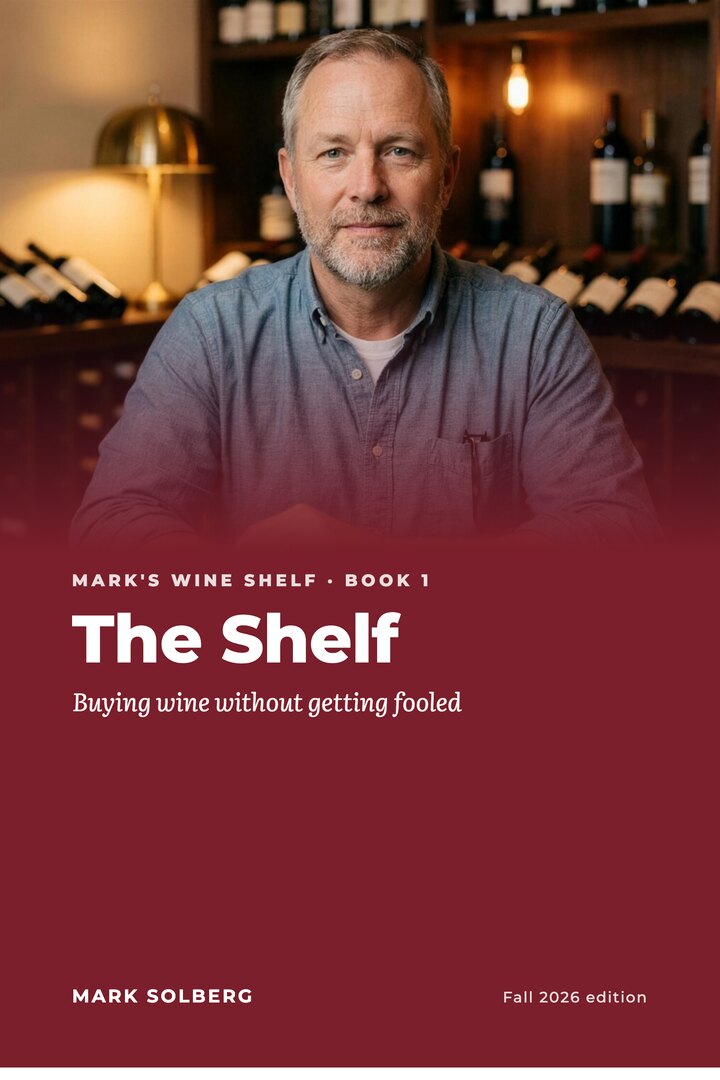
Cover of The Shelf, Book 1 of Mark's Wine Shelf

Book 1 · 110 pages · PDF

The Shelf

Buy the wine, not the label.

  • The one line on the back of every American bottle that tells you who really made the wine. Most people have never read it.
  • What “Reserve” on your usual bottle is actually promising you.
  • Why one bottle in six in US stores has an animal on the label, and what that animal tells you about the wine.
  • What the heavy bottle and the gold sticker are really doing to the price you're willing to pay.
  • The price where paying more stops buying you better wine.
  • Who's behind the Kirkland, Trader Joe's and Aldi wine, and how to look it up yourself.
  • 43 bottles under $20 I'd send a friend to buy, each with the store and the month its price was checked.
  1. Reading the Front Label
  2. Label Tricks
  3. What Price Actually Buys
  4. Store Brands and Who Really Makes Them
  5. Bottles Under $20 I'd Send a Friend to Buy
  6. Talking to a Wine Shop
  7. Buying Wine as a Gift
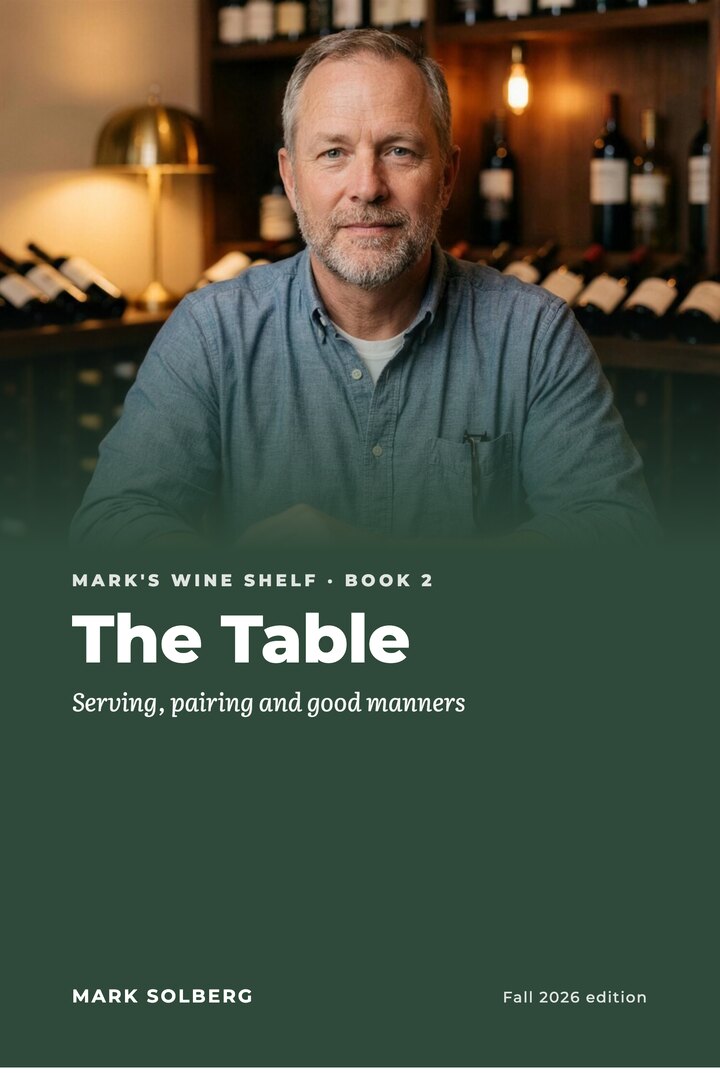
Cover of The Table, Book 2 of Mark's Wine Shelf

Book 2 · 137 pages · PDF

The Table

Serve it like you've done it for years.

  • The one thing I'd change about how most people serve wine at home. It's free, and the same bottle can go from flat and boozy to bright and balanced.
  • The corkscrew worth owning, and the cheap kind that shreds corks.
  • What to do with your glass when someone pours for you, so you never have to wonder again.
  • How to turn down a refill without the host feeling snubbed.
  • How many bottles to buy for a dinner, so you don't run out and don't overspend.
  • How to order from a restaurant list without dreading the bill, and why the cheapest bottle on a good list is nothing to be embarrassed about.
  • Thanksgiving, Christmas and New Year, each at three budgets.
  1. Temperature
  2. Opening the Bottle
  3. Glasses
  4. Pouring and Holding
  5. Decanting
  6. Being a Guest
  7. Being a Host
  8. Restaurants
  9. Pairing Without Rules You'll Forget
  10. Holidays
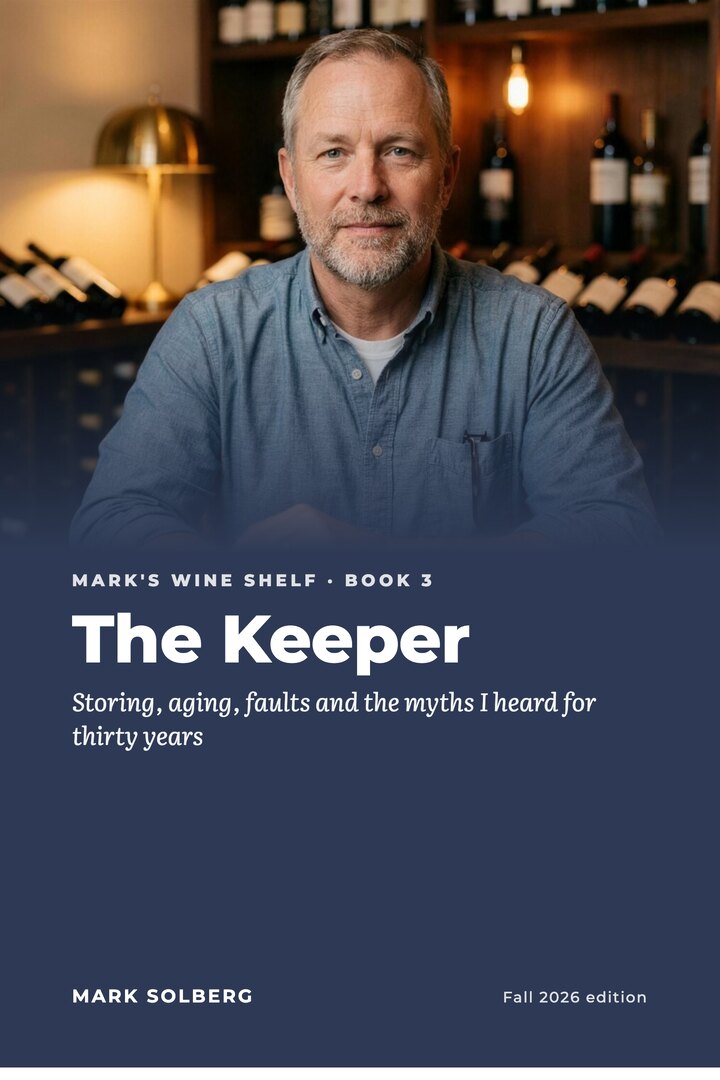
Cover of The Keeper, Book 3 of Mark's Wine Shelf

Book 3 · 109 pages · PDF

The Keeper

Stop losing good bottles to bad habits.

  • Why the top of the fridge is one of the worst places in the house to keep wine.
  • How long that open bottle in your fridge really keeps. Longer than most people think.
  • The bottle you're saving for a special day may already be past its best. How to tell, and when to open it.
  • The smell that means a bottle is faulty, and how to take it back without an argument.
  • Ten things you've probably been told about wine that aren't true.
  • About forty wine names you'll never stumble over again, six printable cards and a tasting journal.
  1. Storing Wine Without a Cellar
  2. How Long an Open Bottle Lasts
  3. What Ages and What Doesn't
  4. When a Bottle Has Gone Wrong
  5. Myths I Heard for Thirty Years
  6. One Drink, the Honest Measure
  7. Say It Without Worrying
  8. Quick-Reference Cards
  9. My Tasting Journal

Look inside

See the pages before you buy

These are real pages from the books. Large, clear type, set for reading on a tablet, a phone, or printed out. Tap any page to read it.

The Shelf · Reading the Front Label
The Shelf · The under-$20 list
The Table · Serving temperatures
The Table · Being a Guest
The Keeper · Say It Without Worrying
The Keeper · Printable cards

Your order

Mark's Wine Shelf, the complete set

  • The Shelf110 pages · PDF
  • The Table137 pages · PDF
  • The Keeper109 pages · PDF, with the pronunciation guide, printable cards and tasting journal

$27one payment for all three · Fall 2026 edition

Get all three books · $27 →

✓ Instant PDF download. 30-day money-back guarantee.

  • Nothing ships. The books arrive as a download link right after you pay.
  • Opens on any phone, tablet or computer. Nothing to install.
  • The link is in your email too, so you can download them again any time.
  • One payment. Never a subscription.

My guarantee

Read them for 30 days. If you don't want them, you get your money back.

Write to us within 30 days and every dollar comes back. I ran a shop on repeat customers; I'd rather lose a sale than have you keep a book you don't need.

Mark Solberg

From the author

What I learned behind the counter

I ran a small independent wine shop in Portland, Oregon for almost thirty years. Before that I worked the floor of a restaurant, and then a few years for a distributor. I'm not a sommelier and I'm not a Master of Wine. What I know comes from selling a lot of bottles, hearing which ones came back, and reading the people who study this properly.

I've been wrong plenty. Early on I lost a customer by giving her five minutes on soil types when she'd asked for a nice red; I never gave that talk again unless someone asked. And every year at my blind tasting, six bottles in brown paper bags, somebody's favourite turned out to be the cheapest one on the table.

What I'm sure of is that a twelve-dollar bottle chosen well beats a forty-dollar bottle chosen by its label, and that wine is for drinking with people, not for impressing them. These books collect what I'd tell you if you walked into my shop.

— Mark Solberg

Is this for you?

Who I wrote these for

This is for you if

  • You buy wine at the grocery store, Costco or a wine shop, and want to choose with more confidence.
  • You'd rather know what a label means than memorise tasting notes.
  • You host now and then and want to get the small things right without fuss.

Probably not for you if

  • You're studying for a sommelier exam. These are practical books, not a course.
  • You want wine to be a status game. I'm on your wallet's side, not the label's.

Questions

Questions people ask

What exactly do I get?

Three PDF books: The Shelf (110 pages), The Table (137 pages) and The Keeper (109 pages), 356 pages in all. The Keeper also includes a pronunciation guide, six printable quick-reference cards and a tasting journal.

Can I read them on my phone or tablet?

Yes. They're ordinary PDFs that open on any phone, tablet or computer. The type is large and the pages are book-sized, so they read comfortably on a tablet and are fine on a phone.

I've never bought an ebook. How does it work?

After you pay, you get a download link on the screen and in your email. Tap it and the books open like any document. Nothing is mailed and there's nothing to install. If anything goes wrong, write to us and we'll walk you through it.

What if I lose the files?

The link stays in your email, so you can download them again. If you can't find the email, the Find my books page sends it again.

Can I print them?

Yes. The cards and the tasting journal in The Keeper are designed to be printed and kept in a kitchen drawer or inside a cupboard door.

I'm new to wine. Is this too much?

No. Nothing assumes you know the jargon, and the pronunciation guide covers the names people are nervous to say. Start with The Shelf if you buy, or The Table if you're hosting soon.

I've been drinking wine for decades. Is there anything new here?

Probably. Plenty of people who've bought wine for years don't know that “Produced and bottled by” and “Cellared and bottled by” mean different things, that an open red keeps 3 to 5 days in the fridge, or that in large blind tastings ordinary drinkers didn't prefer the expensive bottle. The books are full of that kind of thing.

What does Mark look at first on a bottle?

Who made it. On an American bottle, “Produced and bottled by” means that company fermented at least 75% of the wine itself. After that, the grape, the place and the alcohol percentage. The picture, the sticker and the word “Reserve” come last, if at all.

How long does an open bottle keep?

With the cork back in and kept in the fridge: light whites and rosé 5 to 7 days, fuller whites and most reds 3 to 5, sparkling wine 1 to 3 with a proper stopper. A spoon in the neck does nothing.

What should I spend on an everyday bottle?

In most shops the best value sits between $12 and $20. Above that, make sure you know what you're paying for. The Shelf lists 43 bottles under $20 I'd send a friend to buy.

Are the prices current?

This is the Fall 2026 edition. Every bottle in the under-$20 list says which store and which month its price was checked. Prices change and vary by state, so treat them as a guide, not a promise.

Do you sell wine?

No. These books are information only. Nobody paid to be included, and I don't earn anything from the bottles I mention.

Is this about drinking more?

No. It's about enjoying the bottle you were going to open anyway. The Keeper even has a chapter on what one drink actually measures.

How does the money-back guarantee work?

Write to us within 30 days of buying and you get every dollar back. Once an order is refunded, its download link stops working.
Start with the bottle in front of you

If you'd like to choose a bottle by who made it, serve it at the right temperature and know how long it keeps once it's open, these three books give you the plain answers. Open a page, read it, and decide.

Get all three books · $27 →

✓ Instant PDF download. 30-day money-back guarantee.

$27 · 3 books · 356 pagesGet the set →